


When you think of the beautiful city of Zahle, Lebanon—the largest city in the Beqaa Governorate—you may think of its pleasant climate and numerous riverside restaurants along the Berdawni River. But I also think of one classic sweet treat that is an absolute must whenever I visit this lovely city: kaak bhaleeb, or Lebanese milk kaak.
The artisanal bakeries of Zahle are famed for making this delicious traditional pastry. Every time I visit Zahle, I eat a crap-ton of the stuff and buy bags to bring home to my loved ones as delicious edible gifts!
Watch the video tutorial below and learn how to make this beloved Lebanese treat!
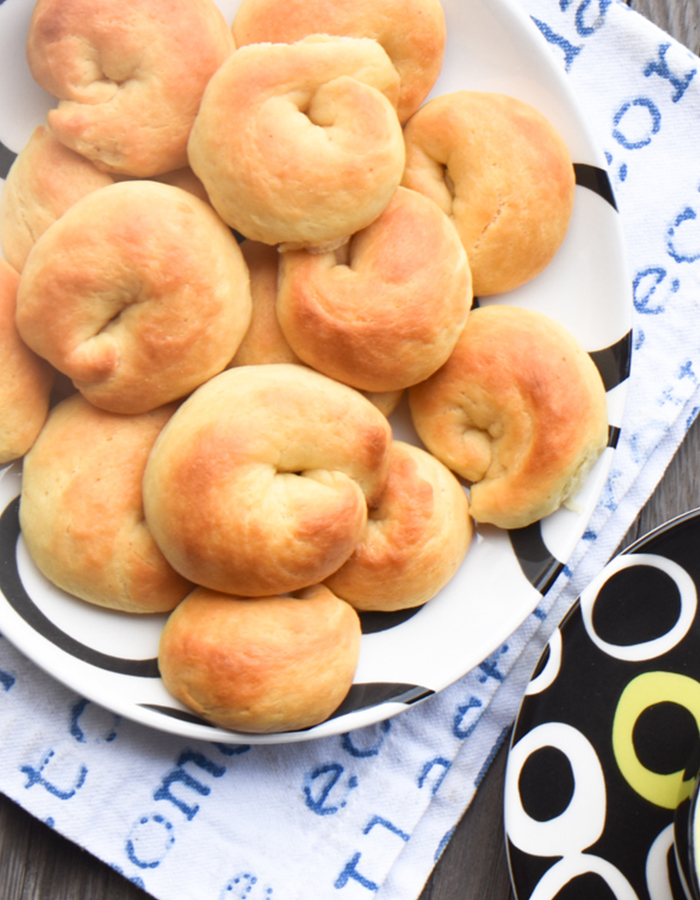
Lebanese Milk Kaak / Kaak Bhaleeb
Lebanese Milk Kaak, or Kaak Bhaleeb, is a beloved sweet ring bread that is plush and pillowy, with a tender crumb that softly melts in your mouth with every bite. It has a beautiful golden hue and a delicate, agreeable mahlab flavor—these just might be the rolls of your dreams.
This Lebanese milk bread is satisfying and special enough to enjoy on its own as a dessert, yet subtle enough to serve for breakfast, especially when dunked into coffee or warm milk.
Tips and Tricks
-
I knead the dough by hand, but you can also use a stand mixer fitted with a dough hook.
-
Not all brands of ghee are equally reliable, so use the best-quality ghee you can find.
-
The dough needs a first rise of about 6 hours, or until it has doubled in size. Once the buns have been shaped, they need a second rise of about 1 hour.
-
Store the baked kaak in an airtight container at room temperature for up to 4 days.

Frequently Asked Questions
What is Mahlab/Mahleb?
Mahlab, or Mahleb, is an aromatic white spice made from the kernels of a particular type of sour cherry. It is widely used in Middle Eastern baking, particularly in breads, pastries, and other baked goods.
Why does “Kaak Bhaleeb” take so long to rise?
Yes, making Kaak Bhaleeb is a waiting game! Sweet bread doughs generally take longer to rise than unsweetened doughs. In addition, the dough in this recipe contains a relatively high amount of fat, which can also slow down fermentation.
It takes approximately 5–6 hours for the dough to double in bulk, so be patient and give the dough the time it needs.
Why does Kaak Bhaleeb need a second fermentation?
The second fermentation gives the shaped kaak time to rise a little further before baking. This helps develop the proper structure, texture, and flavor during baking.
Is rack position important when baking Kaak Bhaleeb?
For most baked goods, positioning the tray in the center of the oven is ideal. Not for this recipe.
For Kaak Bhaleeb, we want the dough to have enough time to rise before the crust forms. Baking the kaak closer to the top of the oven helps achieve this.
Keep in mind that the bread bakes quickly and only needs slight browning. Bake for approximately 12–15 minutes, but keep a close eye on the kaak to prevent it from burning because of the intense heat from the top of the oven.
The bottoms should not be deeply browned. The best way to check if they are done is to gently turn one over and check the bottom—it should be just slightly browned.
Can you chill the dough overnight in the fridge after the first rise?
Yes! And after testing this method, I believe it may be the secret tip that takes your Kaak Bhaleeb to another level.
Refrigerating the dough overnight after the first rise is a great way to develop an exceptionally fluffy, tender, melt-in-your-mouth Kaak Bhaleeb. I know most people don’t have the time to wait around for the dough to rise, but if you can plan ahead, I highly recommend trying this method.
The next day, take the dough out of the refrigerator and let it sit on the counter until it comes back to room temperature. Shape the dough into rings, then let the shaped kaak rest for another hour for the second fermentation.
Bake as directed in the recipe, and enjoy!

Storage: Enjoy them warm, or let the leftovers firm up slightly and cool to room temperature. Store them in a plastic bag or airtight container to preserve their freshness for up to four days.
Lara Sacre Sassine said: “I’ve tried many recipes, and this is the best kaak bhalib ever!”
 Let’s Stay in Touch!
Facebook, Instagram, YouTube , Pinterest and TikTok!
Lebanese Milk Kaak / Kaak Bhaleeb
Description
Ingredients
- 500 grams / 1 lb 2 oz all-purpose flour about 3¾ cups
- 150 grams / 5.3 oz granulated sugar ¾ cup, for the dough
- 1 tablespoon sugar for proofing the yeast
- ¼ cup water for dissolving the yeast
- 3 tablespoons whole milk powder
- ¾ cup water
- ½ teaspoon mahlab
- 75 grams / 2.6 oz ghee 3 tablespoons
- 75 grams / 2.6 oz butter 3 tablespoons
- 1 tablespoon instant dry yeast
- 1 heaped teaspoon baking powder
- Additional ghee for greasing the baking sheet and brushing the kaak after baking
Instructions
- Dissolve the yeast in ¼ cup of warm water (120°F/50°C) with the sugar. Set aside and wait until the mixture becomes creamy and develops small bubbles on top.
- Transfer the flour to a large bowl and add the sugar, mahlab, and baking powder. Mix well and set aside.
- Dilute the powdered milk in ¾ cup of water and warm until lukewarm. Melt the butter in a small saucepan over low heat, add the ghee, and mix with the lukewarm milk. Transfer the butter-and-milk mixture to the flour bowl, then add the activated yeast.
- Knead the dough for 10 minutes, occasionally slapping it against the bowl or work surface to help develop the gluten. Cover with cling film to prevent the dough from drying out, and place it in a warm spot until it doubles in size. This takes about 5–6 hours—yes, really! Sweet bread doughs take longer to rise than unsweetened doughs.
- This step is optional, but highly recommended! Once the dough has doubled in size, place it in the refrigerator and let it chill overnight. I believe this is the secret that takes Kaak Bhaleeb to another level. An overnight rest in the refrigerator after the first rise is a smart way to achieve the fluffiest, most melt-in-your-mouth Kaak Bhaleeb.
- Grease a large baking sheet with ghee.
- Divide the dough into equal portions, roughly the size of a ping-pong ball, or slightly smaller.
- Roll each piece between the palms of your hands to form a rope about 7 cm (2.5 inches) long. Pinch the ends together to form a circle.
- Place the kaak on the greased baking sheet, leaving some space between each one. Cover with a plastic bag and leave to rise for 1 hour for the second fermentation.
- Meanwhile, preheat the oven to 220°C/428°F.
- Bake the milk kaak on the upper-third rack of the oven. This allows the dough enough time to rise before the crust forms. Be careful, as the kaak bake quickly and should only be lightly browned. Bake for about 12–15 minutes, keeping a close eye on them to prevent burning, especially because of the high heat at the top of the oven. You may need to rotate the baking sheet halfway through to ensure even browning.
- Remove from the oven and immediately brush the top of each milk kaak with a little ghee.
- Enjoy them warm, or allow the leftovers to cool completely and firm up slightly. Store them in a plastic bag to preserve their freshness for up to four days.
- Watch the video tutorial! Happy eating!
























7 Comments
My mom and grandmother made these every Easter recipe is very similar but used whole milk, cinnamon and orange blossom water. They did not use Ghee and They never raised in refrigerator but think I will try a few this year that way. I do let my rough raise overnight.
We prefer them filled with walnuts. My family would press the round rings onto a mesh screen to leave a small imprint on each of the plain ones.
That sounds interesting, care to share the recipe?
Hi Hadia. I love kaak bhaleeb so I tried to use your recipe but for some reason when I checked the measurements something doesn’t add up or may be I am not reading your recipe correctly.
When you double or triple the recipe the amount of flour changes in grams but the cup measurements stay the same 3 3/4 cups throughout. 1000 gr makes approx 8 cups. Same thing for the sugar.
Do you mind clarifying this for me.
Thanks for posting this recipe.
Best regards
Leila
Trying it now…veganized! Leaving it to rise then will refrigerate as recommended! Can’t wait to try them on the morning!!
Having only ever had these from our local, arab grocery store, I’ve never had a FRESH one!
I hope you enjoy it as much as we do, let me know how your vegenized version worked for you, xoxo.
These freeze really well (even my veganized version!) I used oat milk instead of the 3/4c water with milk powder and vegan butter instead of both the butter and the ghee!
Deeeelicious!
Francine, thank you for the feedback, I am thrilled to know you enjoyed even with the tweaks you did., xoxo